Faith, Power, and the War in Ukraine · Part 3
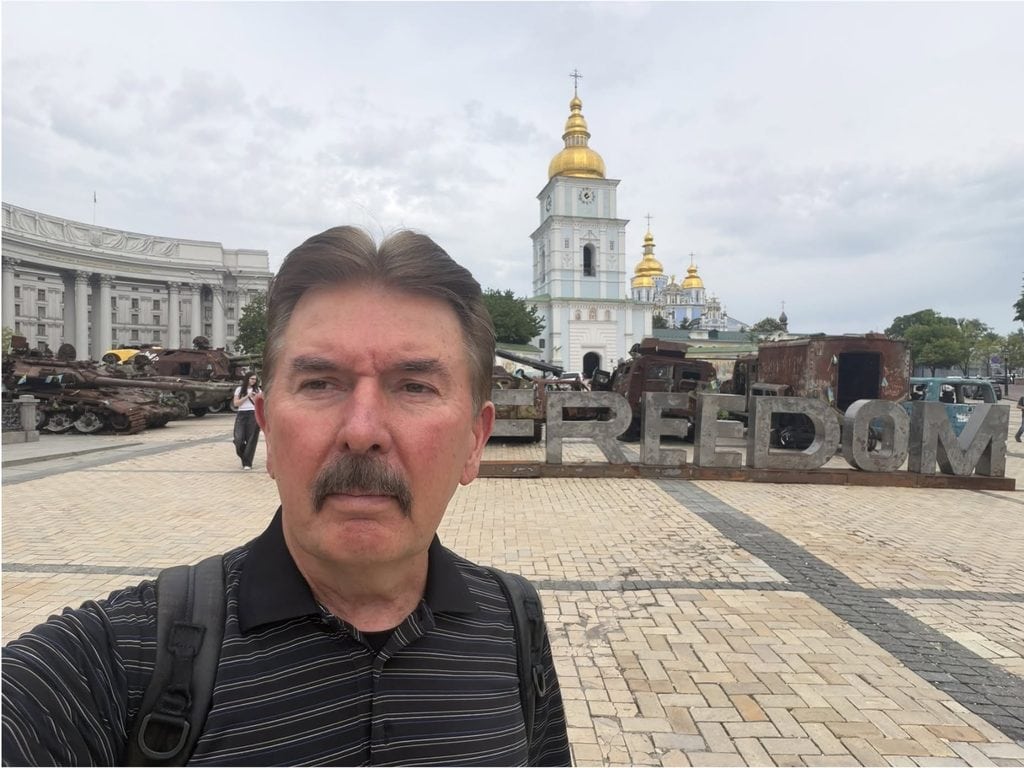
In Part 1, I shared what I have witnessed in Ukraine. In Part 2, I examined Russia’s broken commitments. Now I want to look at how we arrived here and the questions that record requires us to ask.
In this post and the next several that follow, I will examine the political, economic and religious developments behind Russia’s war against Ukraine.
We will examine dates, speeches, government and church documents, treaties, economic decisions, wars, and statements made by Putin and Patriarch Kirill, head of the Russian Orthodox Church.
My work in Ukraine gives these questions a personal urgency. My background in history and analysis tells me we need to examine how the events fit together.
Christian Discernment and the Search for Truth
And I approach all of this as a Christian. I am a licensed minister in the Evangelical Free Church of America and hold a certificate in Biblical Counseling.
So, the questions I am asking are not exclusively geopolitical. I am asking what happens when political power, nationalism, religious institutions and Christian language begin to merge. I am asking whether Christians can hear words such as faith, family, traditional values, Christian civilization, and even God and still carefully examine what those words are being used to justify.
I am not asking you to accept my conclusions because of my background. I am telling you my background, so you understand why I believe we need to consider these questions.
…but test everything; hold fast what is good.
1 Thessalonians 5:21 (ESV)
It is the glory of God to conceal things, but the glory of kings is to search things out.
Proverbs 25:2 (ESV)
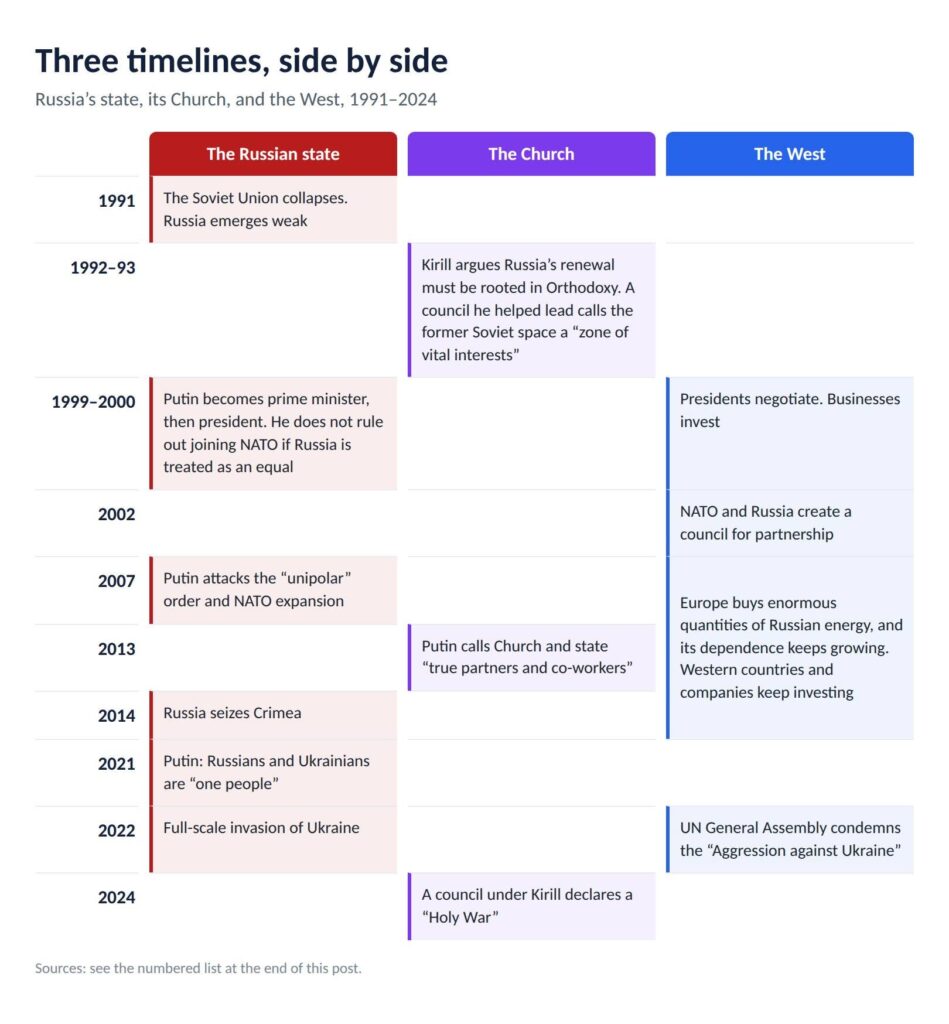
Let’s consider the timeline.
Putin and the Rebuilding of Russian Power
The Soviet Union collapsed in 1991. Russia emerged economically weak, politically unstable and militarily diminished. But the ideas that would later become important did not suddenly appear in 2022. They developed over decades.
Putin’s rise to power began in the early 1990s and accelerated in 1998, when he became director of Russia’s Federal Security Service (FSB). In August 1999, Boris Yeltsin appointed him prime minister and publicly identified him as his preferred successor. When Yeltsin resigned on December 31, 1999, Putin became acting president. He was elected president in March 2000.
Putin came out of the Soviet Committee for State Security (KGB). He served in it for sixteen years, in Leningrad and then in Dresden, East Germany. In December 1989, as crowds surrounded the KGB building there, he asked Soviet forces for help and, as he later recalled, was told: “Moscow is silent.” He said he felt then that the country had disappeared. For Putin, the Soviet Union and Russia are one and the same: the same land, the same people, the same “historical Russia.” In December 2021 he still described the Soviet collapse as “the collapse of historical Russia.”
Putin initially pursued cooperation with the West, and in 2000 he did not rule out Russia joining the North Atlantic Treaty Organization (NATO) if it were treated as an equal partner. But by 2007 he was publicly attacking what he called the “unipolar” international order and objecting strongly to NATO expansion. In 2014, as Russia seized Crimea, Putin described Russians as a people divided by the collapse of the Soviet Union and portrayed Crimea’s separation from Russia as a historical injustice. And in 2021, Putin published an essay saying that Russians and Ukrainians were “one people” and parts of the same historical and spiritual space.
In February 2022, Russia launched its full-scale invasion of Ukraine.
Kirill and Religious Authority
“For such men are false apostles, deceitful workmen, disguising themselves as apostles of Christ. And no wonder, for even Satan disguises himself as an angel of light. So it is no surprise if his servants, also, disguise themselves as servants of righteousness. Their end will correspond to their deeds.”
2 Corinthians 11:13–15 (ESV)
But there is another timeline running beside the political one. In 1992–93, Kirill, who later became head of the Russian Orthodox Church, argued that Russia’s renewal should be rooted in its Orthodox Christian heritage and that the breakup of the Soviet Union had not erased the religious and cultural bonds among its peoples. In May 1993, a council Kirill initiated and helped lead declared the entire former Soviet space a “zone of vital interests” of the Russian people, said Russia could not allow its parts to join “blocs and alliances hostile to it,” and spoke of the “peaceful restoration of a single state.”
Russia had no power then to act on those words. It said them anyway.
Over the succeeding years, Kirill continued to develop these religious and political ideas. On 27 March 2024, the World Russian People’s Council approved a declaration under Kirill’s chairmanship calling the war in Ukraine a “Holy War” and demanding that all modern Ukraine fall within Russia’s exclusive influence. The declaration portrays Russia as defending Christianity against a West it describes as having fallen into Satanism. It assigns Russia and the “Russian world” a spiritual mission as the historical force restraining evil and holding back the Antichrist. Kirill’s statements about the Western Church’s apostasy, turning away from the faith, and Russia’s “spiritual mission” frame the confrontation as a struggle to preserve Christianity and rescue a West that is lost.
The Partnership Between Church and State
Put those timelines beside each other: political power, military power, economic power, historical grievance, civilizational identity, religious authority, sacred language, war.
These were not two separate stories. The Orthodox Church and the Russian state built them together. In July 2013, hosting Kirill and the heads of other Orthodox churches in the Kremlin, Putin described the relationship in his own words: “We act as true partners and co-workers in tackling the most urgent internal and international tasks.”
The West’s Search for Cooperation
Then add another timeline. For decades the West continued trying to build a cooperative relationship with Russia. Presidents negotiated. Europe bought enormous quantities of Russian energy. Businesses invested. NATO established mechanisms for partnership. Political leaders repeatedly hoped Russia could become part of a stable European and international order.
Some of those decisions were understandable. But eventually a different question must be asked:
At what point does the accumulating evidence become a pattern?
The posts that follow will trace how these developments converged, and what that means for Ukraine, the West, and the Church.
Seeing creates responsibility. I ask you to follow the evidence through this series, consider what it reveals, and act.
Please take action
Please contact your United States senators and your representative in Congress. Tell them plainly:
“I support Ukraine. I oppose Russian aggression. I want the United States to stand firmly with Ukraine and help it defend its people, freedom, and sovereignty. Russia should not be rewarded for taking another country’s territory by force.”
Do not assume someone else will speak. A phone call or an email takes only a few minutes.
You can also call the U.S. Capitol switchboard at (202) 224-3121 and ask to be connected to your senators or representative.
Find and contact your U.S. representative:
https://www.house.gov/representatives/find-your-representative
Find and contact your U.S. senators:
https://www.senate.gov/senators/senators-contact.htm
Find and contact elected officials | USAGov
Use USAGov’s Contact Your Elected Officials tool to get contact information for your members of Congress, the president, and state and local officials.
https://www.usa.gov/elected-officials
Evil triumphs when good people see what is happening and choose to do nothing.
Please do something.
Please share this post with others.
← Previous: Part 2: Given Russia’s Record, Why Trust Its Next Promise? · Next: Part 4: The Strategy Was Hiding in Plain Sight →
View all articles in this series
Scripture sources
Scripture references: 1 Thessalonians 5:21; Proverbs 25:2; 2 Corinthians 11:13–15.
Scripture quotations are from The Holy Bible, English Standard Version, copyright © 2001 by Crossway, a publishing ministry of Good News Publishers. Used by permission. All rights reserved.
Sources
1. Congressional Research Service, Russian Political Economic and Security Issues and U.S. Interests, 7 March 2014
https://www.everycrsreport.com/files/20140307_RL33407_6682d0ff30cb4255ec3ec38bd4ec30b552a73683.pdf
2. United Nations Library, Russia and the Soviet Union’s United Nations membership
3. World Bank, Russia Systematic Country Diagnostic, 2016
4. Vladimir Putin, Munich Security Conference speech, 10 February 2007; English text reproduced on Wikisource
5. Vladimir Putin, Crimea address, 18 March 2014; English text reproduced on Wikisource
6. Vladimir Putin, On the Historical Unity of Russians and Ukrainians, 12 July 2021; English text reproduced on Wikisource
https://en.wikisource.org/wiki/On_the_Historical_Unity_of_Russians_and_Ukrainians
7. Kirill, 1992 address, Journal of the Moscow Patriarchate, April 1992; Russian original, printed page 7, PDF page 9
https://s3.regru.cloud/jmp-pdfs/1992/JMP_1992-04.pdf
8. Kirill, 1993 address, Journal of the Moscow Patriarchate, September 1993; Russian original
https://s3.regru.cloud/jmp-pdfs/1993/JMP_1993-09.pdf
9. World Russian People’s Council declaration, 27 March 2024; Russian original
https://sobor.patriarchia.ru/article/105523
10. World Council of Churches response to the March 2024 declaration; English
11. British Broadcasting Corporation (BBC) Breakfast with Frost interview with Vladimir Putin, 5 March 2000; Internet Archive copy of the BBC’s complete transcript
12. North Atlantic Treaty Organization–Russia Relations A New Quality, Rome Declaration, 28 May 2002
13. United Nations General Assembly resolution ES-11/1, Aggression against Ukraine, 2 March 2022
https://digitallibrary.un.org/record/3965290
14. Kirill’s address to Russia’s Federation Council, 23 January 2024; official English transcript
https://mospat.ru/en/news/91290/
15. Kirill on the war as a clash of civilizations, 19 July 2023; official English report
https://mospat.ru/en/news/90541/
16. Kirill’s answers at the Faith and Word festival, 16 October 2025; official Russian transcript
https://edinstvo.patriarchia.ru/article/117794
17. A holy war The Russian Orthodox Church blesses the war against the West, Centre for Eastern Studies (OSW), 12 April 2024; analysis
18. World Russian People’s Council, Address “On understanding the national interests of Russia and the Russian people,” May 1993; Russian original from the council’s site (archived 16 May 2021)
19. Putin, meeting with heads and representatives of Local Orthodox Churches, 25 July 2013; official English report
https://old.mospat.ru/en/2013/07/25/news89202/
20. Encyclopaedia Britannica, “Vladimir Putin” (FSB director 1998; prime minister August 1999; acting president 31 December 1999; elected March 2000)
https://www.britannica.com/biography/Vladimir-Putin
21. The Moscow Times, “Putin Recalls Fall of Berlin Wall in New Film,” 29 October 2009 (quoting Putin’s 2000 book-length interview, First Person)
https://www.themoscowtimes.com/archive/putin-recalls-fall-of-berlin-wall-in-new-film
22. Al Jazeera, “Putin says he drove cab after Soviet fall,” 13 December 2021
Further reading
For readers who want to go deeper. These are background works, not sources for specific claims above.
• Catherine Belton, Putin’s People: How the KGB Took Back Russia and Then Took on the West (Farrar, Straus and Giroux, 2020); review by Joshua Huminski, Diplomatic Courier
• Brian D. Taylor, “The Russian Siloviki & Political Change,” Dædalus, Spring 2017
https://www.amacad.org/publication/daedalus/russian-siloviki-political-change
2 thoughts on “Part 3: Do You Have Eyes to See?”