
Part 4 of the series Faith, Power, and the War in Ukraine. Start at the beginning →
Before I tell you what I think it means, I want to show you what happened.
In my previous post, I asked: Do you have eyes to see? Now I want you to look at the pattern.
My argument is behavioral. It flows from what Russian political and Church leaders said, what Russia rebuilt, and what it did as its power recovered. The strategy I see was hiding in plain sight: public ambitions were repeatedly discounted while assurances of cooperation were taken at face value.
Consider the sequence.
Ambition During Russia’s Weakness
In the early 1990s, Russia faced economic contraction, deteriorating armed forces and unstable institutions. The 1998 financial crisis exposed the state’s weakness. It remained a nuclear power, but its capacity to project conventional military and economic power was sharply constrained (sources 4 and 5).
Yet arguments for preserving the former Soviet space as a common whole were already public. On 17 January 1992, Metropolitan Kirill addressed army and navy officers at the Kremlin. He acknowledged the new sovereign states but urged them to exercise voluntary restraint in their sovereignty, especially in building separate armed forces. He argued that borders could not sever their peoples’ longstanding community. He explicitly presented this restraint as voluntary and free of external pressure (source 53; translation and paraphrase from Russian).
In 1993, Kirill helped initiate the World Russian People’s Council, creating a continuing public forum for discussion of Russian identity, statehood and communities beyond Russia’s borders (source 54). These early statements provide the language of a common historical space that preceded Putin’s presidency.
Then the direction began to change.
Rebuilding Russian Power
As Putin rose to power in 1999–2000, the Russian economy began recovering. Oil and gas revenues increased. Government finances improved. Foreign reserves grew. Moscow began rebuilding the military and restoring the capacity of the Russian state.
Putin spoke about restoring order, strengthening the state and recovering Russia’s strategic position. His 2000 address warned against strategic defeat.
He had set out part of his thinking even earlier. In a 1999 article published under his name, Putin wrote that the state “has the right to regulate” the development and use of Russia’s natural resources, and that without state support and large national corporations Russia could not “compete on equal terms with Western transnational corporations.”
Putin also drew on the military and security services. Kryshtanovskaya and White’s research, as summarized in source 39, reported that about a quarter of a selected political elite sample had military education in 2002, compared with 6.7 percent in 1993; the Security Council figure was 58.3 percent. In 2003, Kryshtanovskaya estimated that about 60 percent of Putin’s inner circle came from military or security backgrounds (source 40). While estimates vary depending on the authors, they all agree about the growing influence of the siloviki (Russian military, security, intelligence, and law-enforcement personnel).
At almost the same time, Putin presented Russia as open to cooperation with the West. In his 5 March 2000 interview on the British Broadcasting Corporation’s (BBC) Breakfast with Frost, hosted by David Frost, he did not rule out possible membership in the North Atlantic Treaty Organization (NATO) if Russia were treated as an equal partner. The same interview expressed opposition to NATO’s eastward expansion. Two years later, NATO and Russia created the NATO–Russia Council to work as equal partners in areas of common interest.
Russia was still rebuilding. It was not yet capable of challenging the Western system directly on anything approaching equal military or economic terms. Accommodation, partnership, and demands for recognition as an equal characterized much of Russia's public posture during this period.
Europe’s Dependence and Russia’s Rearmament
Meanwhile, much of Western Europe was taking advantage of the post-Cold War peace dividend. Defense efforts declined, commercial ties with Russia deepened, and Europe became increasingly dependent on Russian energy. The arrangement appeared mutually beneficial: Europe received energy; Russia received revenue. Increasingly, Russia also received leverage.
Russia’s economy strengthened. State finances improved. Military spending recovered from its post-Soviet collapse. Energy exports generated enormous income. Political authority became increasingly centralized. The security services regained influence. The Russian military was modernized.
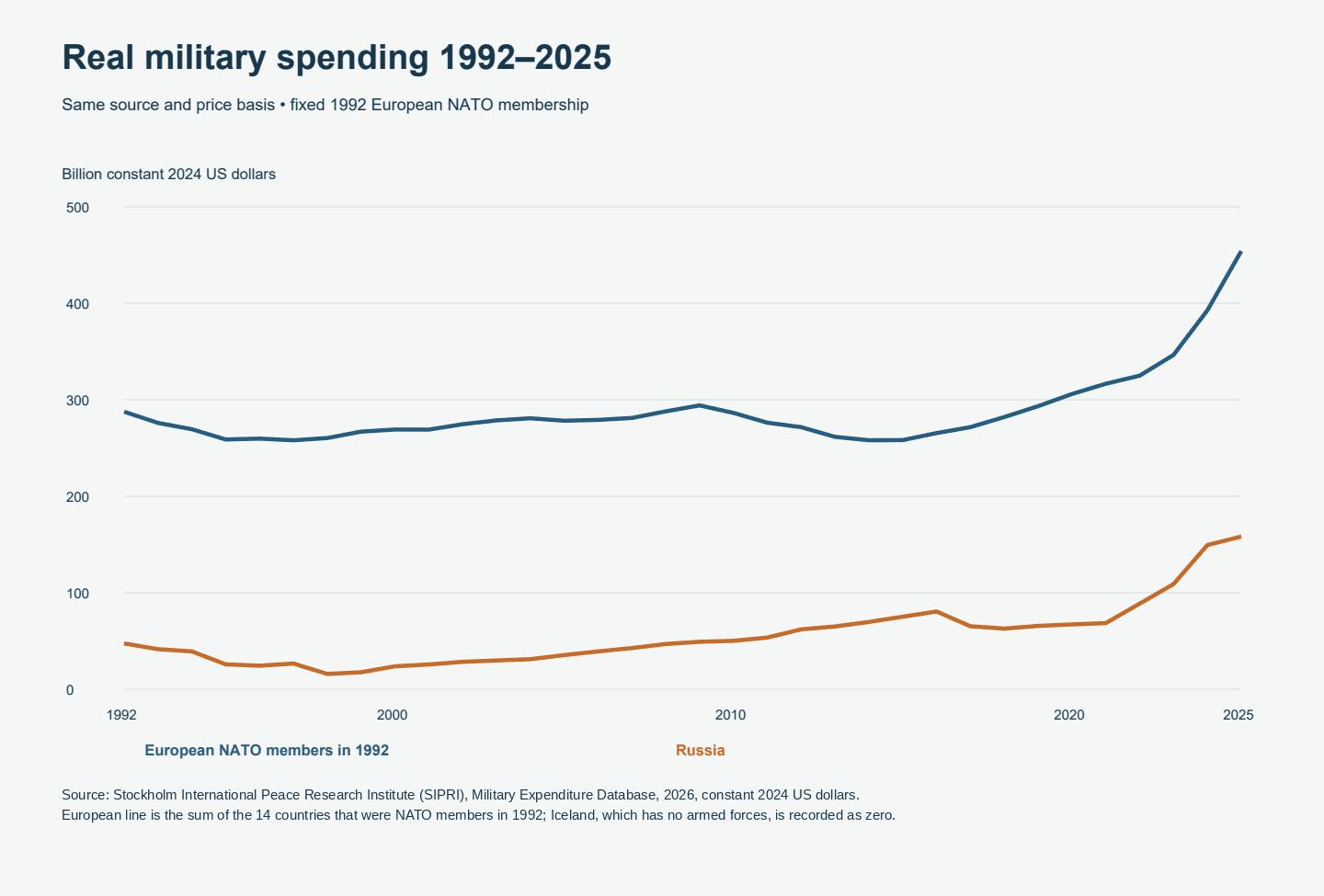
Figure 1. Military spending by Russia and European NATO members, 1992–2025, in constant 2024 US dollars. The European group is fixed at the fourteen countries that were NATO members in 1992.
Russia’s military rebuilding is measurable. The first chart shows military spending in constant dollars. The second shows how that spending changed from each group’s 1992 starting point. Together, they show the scale of Russia’s recovery and expansion.
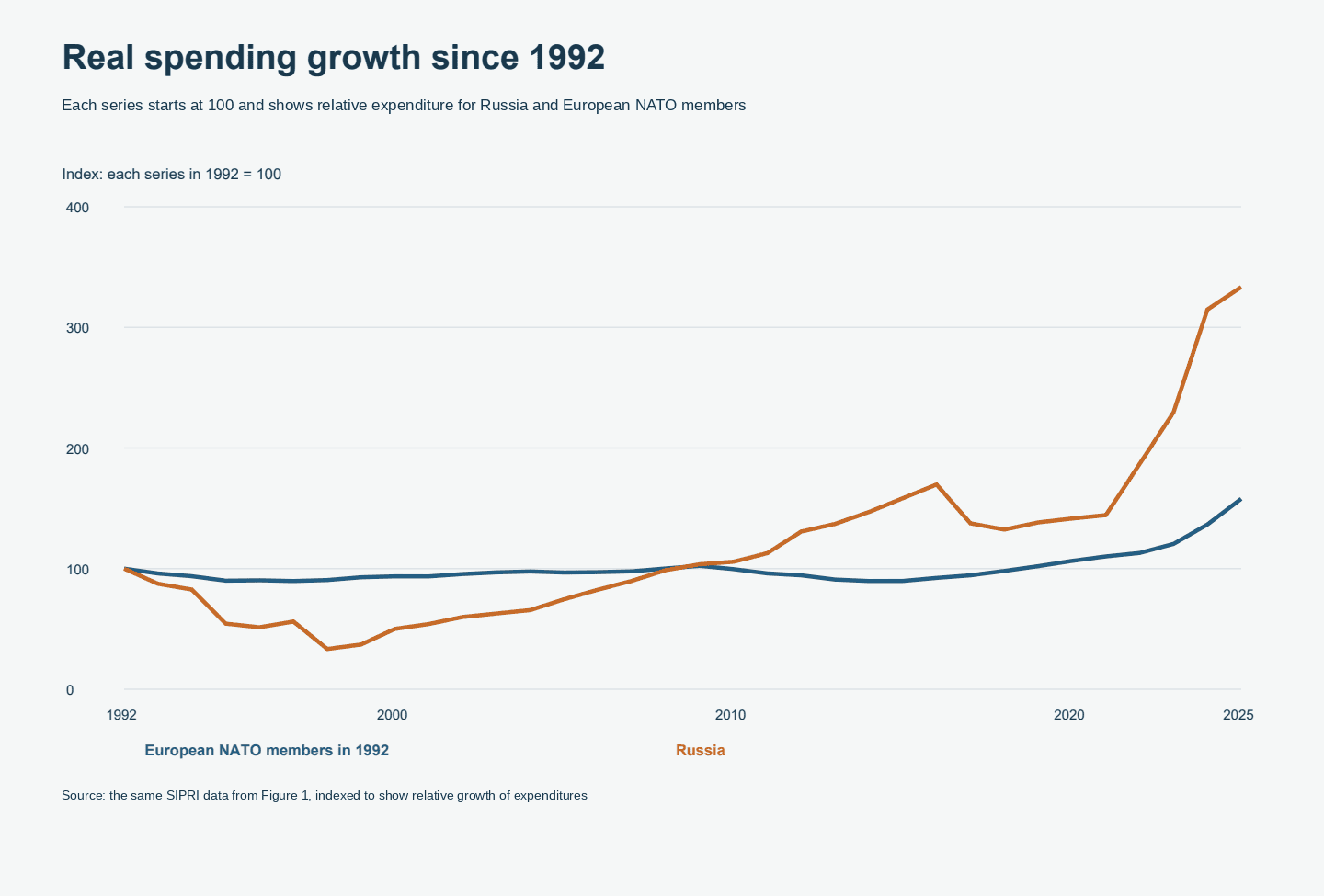
Figure 2. Real spending growth since 1992. Each series starts at 100 and shows relative expenditure for Russia and European NATO members.
Absolute dollars of expenditures do not tell the whole story. Considering Russia’s production costs (labor and material), sources estimate Europe’s 2024 spending advantage at about 1.6 to one, compared with more than three to one at market exchange rates. Based upon that estimate, Russia has roughly twice the relative purchasing power per market-rate dollar. Figure 3 uses a broader European comparison group than the fixed 1992 NATO group in Figures 1–2.
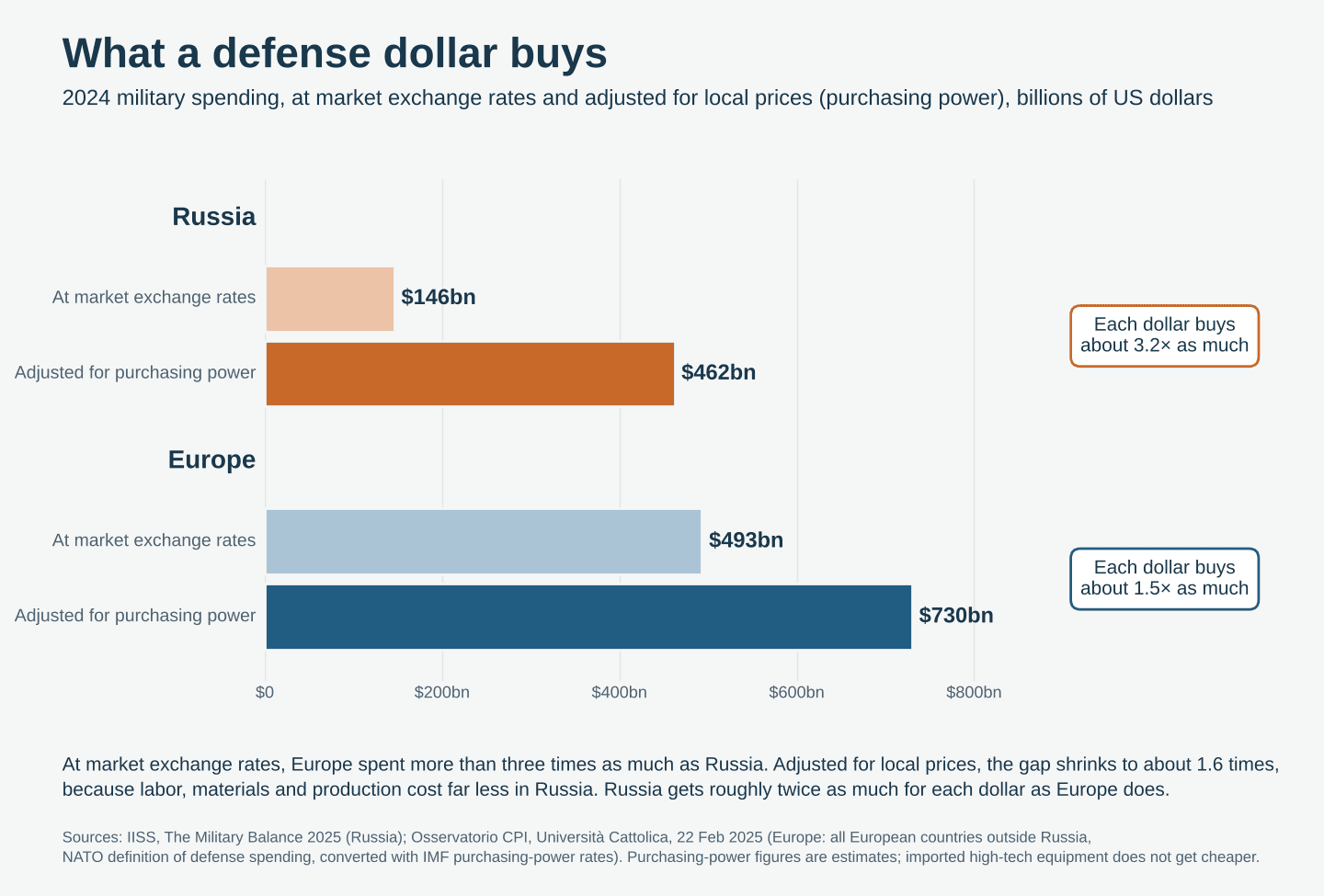
Figure 3. What a defense dollar buys: 2024 military spending by Russia and Europe, at market exchange rates and adjusted for local prices (purchasing power).
As Russian Capability Increased
Then watch what happened as Russian capability increased. In 2005, Putin called the collapse of the Soviet Union a major geopolitical catastrophe. In 2007, at the Munich Security Conference, he attacked the post-Cold War unipolar order and condemned NATO expansion. In 2008, Russia went to war with Georgia. In 2014, Russia seized Crimea.
Crimea is particularly revealing. Putin initially denied that the armed men occupying strategic sites were Russian soldiers and described them as local self-defense forces. He later acknowledged that Russian servicemen had stood behind them (sources 19, 20, and 49). Russia annexed Crimea. In 2021, Putin argued that Russians and Ukrainians were historically “one people” (source 21). In the weeks before February 2022, Russian officials repeatedly denied plans to invade Ukraine. Russia invaded anyway (sources 31, 32, and 33).
Western sanctions and military reassurance measures did not reverse the annexation. And despite Russian actions, significant commercial ties continued, and in September 2015 Gazprom and five European energy companies signed an agreement on Nord Stream 2 (sources 11 and 55). The West’s response failed to deter further aggression. In fact, the West’s continued cooperation with Russia showed that the West would continue to do business with Russia and it gave Russia increasing revenues, room to rebuild, and license to continue its aggressive behavior.
In Post 2, I examined the commitments Russia made to respect Ukraine’s sovereignty and borders, and how Russia violated them. Here, the question is how Russia rebuilt the power to impose its will.
Deception as a Strategy
I compare the strategy Russia followed after the fall of the Soviet Union to Sun Tzu’s The Art of War, the ancient Chinese treatise on war strategy written about 2,500 years ago. Sun Tzu’s treatise includes a blunt principle: “All warfare is based on deception.” He taught that “when able to attack, we must seem unable,” and “if he [the enemy] is in superior strength, evade him.” The good fighters of old first made themselves secure and then “waited for an opportunity of defeating the enemy” (source 41). The analogy is clear: agree to terms while weak, buy time and rebuild, then act more aggressively as power grows. This is exactly what Putin did. Another Chinese classic of strategy, The Thirty-Six Stratagems, offers a related maxim: “Hide a knife behind a smile” (source 42). The comparison comes from Russia’s public conduct: cooperate while constrained, rebuild strength, exploit dependence and division, then use force to restore Russian dominance. There is a deliberate strategic progression.
The Russian military doctrine of maskirovka is also built on deception. It uses concealment, camouflage and disinformation to mislead an opponent. A later account quotes Soviet military strategist Vasilii Reznichenko’s 1966 definition, including “concealing true targets and installing simulated ones” (source 49). Crimea, as described above, illustrates its application. Soviet theorists also developed the concept of “reflexive control,” which shapes the assumptions on which an opponent makes decisions (source 50). These concepts help explain how public ambitions can coexist with misleading assurances. Russia’s disregard of signed agreements shows its willingness to break almost any agreement once it no longer serves its purposes.
Judge my interpretation against what Russia said and did.
Weakness → Cooperation while rebuilding → Greater economic and military power → Leverage over Europe → More aggressive demands → Force to restore Russian dominance.
Russia’s ambitions did not have to remain secret for deception to work. Leaders could speak publicly of historical unity while offering assurances that encouraged others to discount the political consequences. As Russia rebuilt its power, its demands became more confrontational and its use of force more extensive. Figure 4 shows how the language hardened as military spending rose.
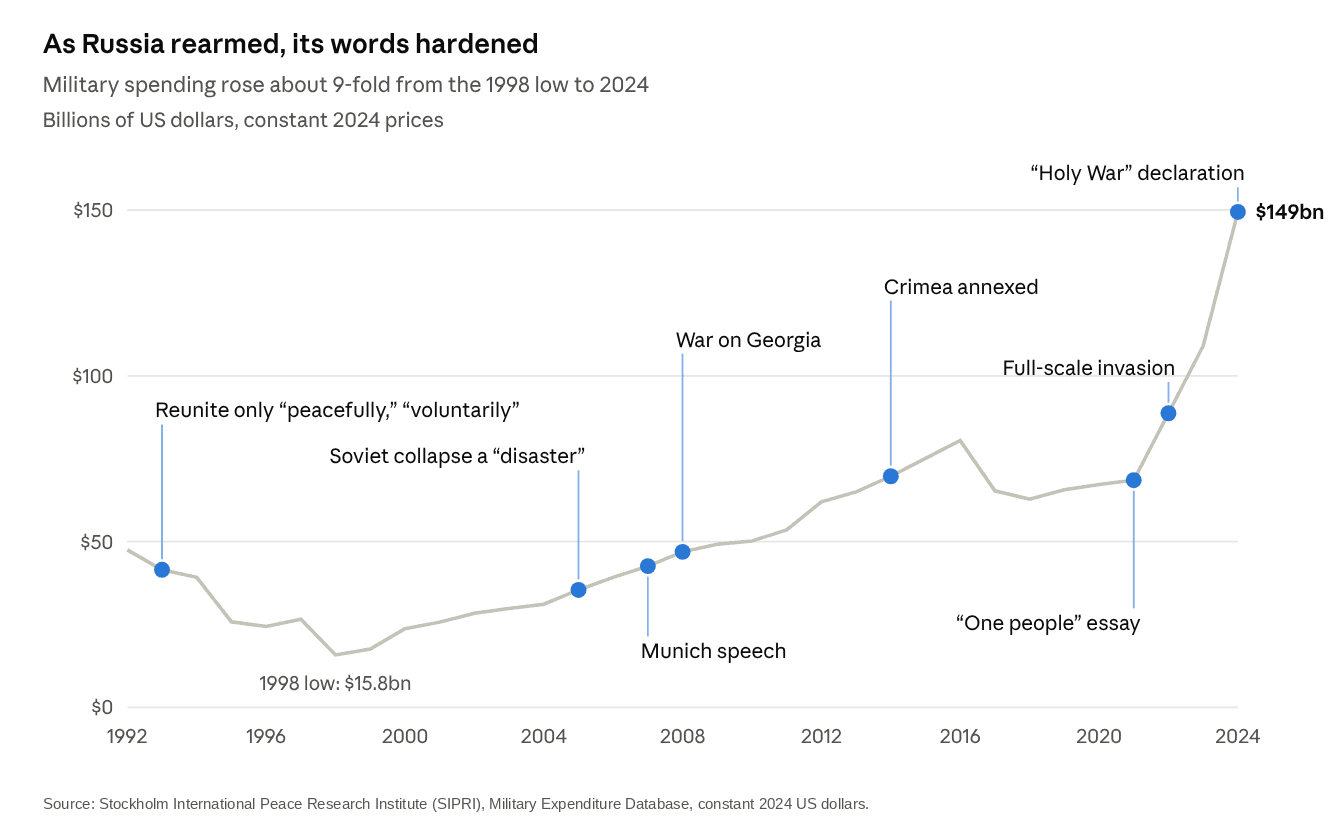
Figure 4. Russia’s military spending, 1992–2024, constant 2024 US dollars, with key statements and actions marked. Spending fell to about $16 billion in 1998 and reached about $149 billion in 2024, roughly nine times higher.
The Expansion of Russia’s Armed Forces
The size of the armed forces followed a different path from spending. Early reforms reduced personnel while providing better pay, equipment and readiness. Since the full-scale invasion, Putin has increased the authorized service-member ceiling seven times, reaching 1,550,500 in September 2026. These are positions authorized by decree, not a count of personnel serving (sources 43 and 44).
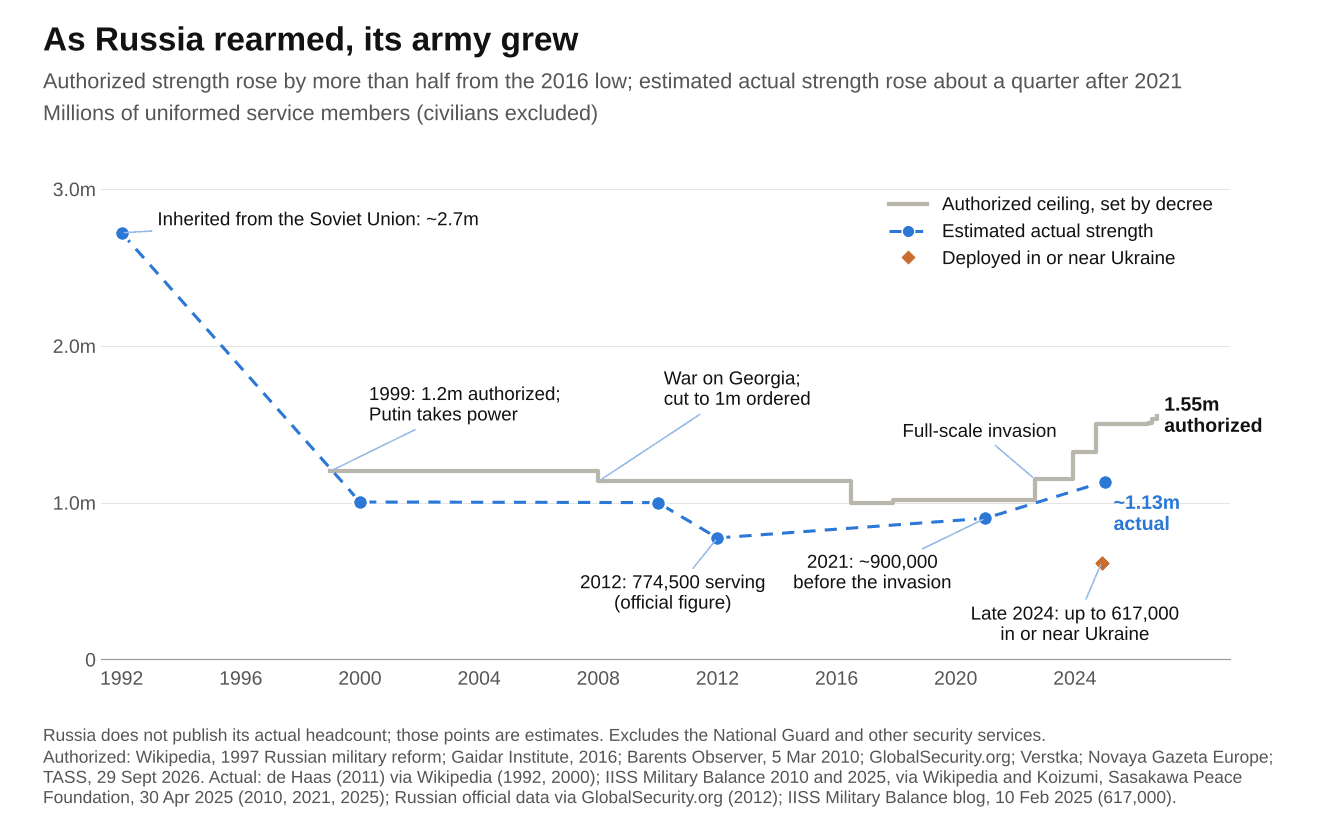
Figure 5. Russia’s military personnel, 1992–2026. Gray shows authorized ceilings set by decree; blue shows independent estimates of the troops actually serving. Russia does not publish its actual headcount. Excludes the National Guard and other security services.
Power is more than money
That is where the partnership between Putin’s state and Kirill’s Church institutions becomes strategically important. The connection reaches back beyond the current war. Kirill’s 1992 appeal for restraint in the sovereignty of the new states was framed in shared history and security. By 2024, the World Russian People’s Council, meeting under his chairmanship, adopted a program addressed to Russia’s legislative and executive authorities that called the war a “Holy War” (sources 30 and 53).
1 “I have said all these things to you to keep you from falling away. 2 They will put you out of the synagogues. Indeed, the hour is coming when whoever kills you will think he is offering service to God. 3 And they will do these things because they have not known the Father, nor me.”
John 16:1–3 (ESV)[S1]
Calling aggression a “holy war” does not make it holy, nor does it make it just.
The same 2024 document demanded that all of modern Ukraine enter Russia’s exclusive sphere of influence. It called for Russia to lead integration throughout the entire post-Soviet space and made the reunification of Russians, Ukrainians and Belarusians a foreign-policy priority (source 30, sections 1–3). This is explicit public evidence of geopolitical ambition expressed in religious and civilizational language.
Coercion compels obedience. Sacred meaning can help sustain it.
The state supplies law, coercive power, mobilization, media reach, and military force. Church institutions supply sacred history, moral vocabulary, providential mission, ritual, and theological legitimacy. Together, those mechanisms can help sustain a struggle far longer than coercion alone.
That is why the sequence matters. The speeches were public. The economic recovery was visible. The military rebuilding was measurable. The energy dependence was visible. Georgia happened. Crimea happened. The religious language intensified. The full-scale invasion happened.
The problem may be that we kept treating each event as separate.
What if they were never separate?
What if the early appeals to preserve a common historical space, the cooperation of the early Putin years, the rebuilding of Russian power, Europe’s growing dependence, the increasingly confrontational rhetoric, the use of force, and the presentation of war as a sacred mission form a connected strategic progression?
That is the argument I am asking you to consider. Western governments too often discounted these public ambitions or assumed that cooperation would contain them. Judge that assessment against the dated statements and actions. Look at the sequence. Then decide whether the strategy was really hiding at all.
SEE. UNDERSTAND. ACT.
I support Ukraine. I oppose Russia's aggression against Ukraine. I believe Ukraine has the right to exist as a sovereign nation and that Russia should not be rewarded for taking another country's territory by force.
Please take action
Please contact your United States senators and your representative in Congress. Tell them plainly:
“I support Ukraine. I oppose Russian aggression. I want the United States to stand firmly with Ukraine and help it defend its people, freedom, and sovereignty. Russia should not be rewarded for taking another country’s territory by force.”
Do not assume someone else will speak. A phone call or an email takes only a few minutes.
You can also call the U.S. Capitol switchboard at (202) 224-3121 and ask to be connected to your senators or representative.
Find and contact your U.S. representative:
https://www.house.gov/representatives/find-your-representative
Find and contact your U.S. senators:
https://www.senate.gov/senators/senators-contact.htm
Find and contact elected officials | USAGov
Use USAGov’s Contact Your Elected Officials tool to get contact information for your members of Congress, the president, and state and local officials.
https://www.usa.gov/elected-officials
Evil triumphs when good people see what is happening and choose to do nothing.
Please do something.
Please share this post with others.
← Previous: Part 3: Do You Have Eyes to See? · Upcoming: Part 5: The Price of Dependence →
View all articles in this series
Scripture sources
Scripture references: John 16:1–3 (ESV). Back to article ↑
Scripture quotations are from The Holy Bible, English Standard Version, copyright © 2001 by Crossway, a publishing ministry of Good News Publishers. Used by permission. All rights reserved.
Sources
1. Basis of the Social Concept complete English text
https://mospatusa.com/files/THE-BASIS-OF-THE-SOCIAL-CONCEPT.pdf
2. Address at Putin meeting with ROC Bishops' Council participants
https://mospat.ru/en/news/47928/
3. Meeting with heads and representatives of Local Orthodox Churches
https://old.mospat.ru/en/2013/07/25/news89202/
4. World Bank Russia Systematic Country Diagnostic, 2016
5. CRS Russian Political Economic and Security Issues and US Interests, 7 March 2014, identified mirror
https://www.everycrsreport.com/files/20140307_RL33407_6682d0ff30cb4255ec3ec38bd4ec30b552a73683.pdf
6. Military Expenditure Database 1949 to 2025 version 1.2
https://www.sipri.org/sites/default/files/SIPRI-Milex-data-1949-2025_v1.2.xlsx
7. Federal Assembly Address , 'must not lose strategically' , Internet Archive copy
https://web.archive.org/web/20260711093124id_/http://www.kremlin.ru/acts/bank/22401/print
8. BBC Breakfast with Frost interview with Vladimir Putin , Internet Archive copy
9. NATO Russia Relations A New Quality
10. EU reliance on Russian natural gas
11. NATO Secretary General Annual Report 2014 official web text
12. OSCE ODIHR final report on Russia presidential election 4 March 2012
https://www.osce.org/sites/default/files/f/documents/2/c/90461.pdf
13. Military Expenditure Transparency Defence Inflation and Purchasing Power Parity
14. Military Balance 2025 public defence spending and procurement trends extract , public extract
15. Annual Address to Federal Assembly , Internet Archive copy
16. Putin, Speech and the Following Discussion at the Munich Conference on Security Policy, 10 February 2007 , English transcript (Kremlin translation) reproduced by Johnson’s Russia List
https://russialist.org/?p=18224
17. Independent International Fact-Finding Mission Georgia, Volume I, September 2009, institutional repository
https://www.mpil.de/files/pdf4/IIFFMCG_Volume_I2.pdf
18. Ukraine and Netherlands v Russia Grand Chamber full judgment publisher hosted court PDF
19. Putin answers journalists on Ukraine, 4 March 2014 , Internet Archive copy
https://web.archive.org/web/20261001154638id_/http://www.en.kremlin.ru/events/president/news/20366
20. Putin Direct Line, 17 April 2014 , Internet Archive copy
https://web.archive.org/web/20261023155757id_/http://en.kremlin.ru/events/president/news/20796
21. On the Historical Unity of Russians and Ukrainians , English text reproduced on Wikisource
https://en.wikisource.org/wiki/On_the_Historical_Unity_of_Russians_and_Ukrainians
22. Memorandum on security assurances in connection with Ukraine accession to NPT
https://treaties.un.org/doc/Publication/UNTS/Volume%203007/Part/volume-3007-I-52241.pdf
23. Helsinki Final Act
https://www.osce.org/sites/default/files/f/documents/5/c/39501_1.pdf
24. Security Council Resolution 2202 with Minsk package and leaders declaration
https://digitallibrary.un.org/record/787968/files/S_RES_2202(2015)-EN.pdf
25. Joint statement on recognition of Donetsk and Luhansk
https://www.osce.org/chairmanship/512686
26. NATO Secretary General Annual Report 2024
https://www.nato.int/content/dam/nato/legacy-wcm/media_pdf/2025/4/pdf/sgar24-en.pdf
27. Executive Order establishing authorised strength of Russia Armed Forces , Internet Archive copy
https://web.archive.org/web/20260608044957id_/http://www.en.kremlin.ru/acts/news/75111
28. NATO military organisation and structures
https://www.nato.int/en/about-us/organization/nato-structure/military-organisation-and-structures
29. Military Doctrine of the Russian Federation, approved 25 December 2014, Kremlin PDF , Internet Archive copy
30. World Russian People’s Council, The Present and Future of the Russian World, adopted 27 March 2024; full text on the Russian Orthodox Church’s official site, Patriarchia.ru (Russian)
https://sobor.patriarchia.ru/article/105523
Back to article ↑ (Citations: 1, 2)
31. Euronews original interview with Vladimir Chizhov, 27 January 2022
32. Russian mission to UN, Nebenzia, 31 January 2022
https://russiaun.ru/en/news/310122o
33. NATO press briefing, 24 February 2022
https://www.nato.int/en/news-and-events/events/transcripts/2022/02/24/press-briefing
34. NATO annual report 2014 (same document as source 11)
35. SIPRI military spending 2025 fact sheet
https://www.sipri.org/sites/default/files/2026-04/2604_milex_2025.pdf
36. Brian D Taylor, State Building in Putin’s Russia, chapter 2 publisher summary , publisher summary only
37. Centre for Eastern Studies (OSW), “A dangerous dependence on Russia: Germany and the gas crisis,” 23 February 2022
38. Kommersant, “From Vladimir Putin’s candidate dissertation,” 2 February 2005 (Russian; excerpts, citing his January 1999 article “Mineral Natural Resources in the Strategy for Development of the Russian Economy”)
https://www.kommersant.ru/doc/543802
39. Riddle Russia, “Is Russia a militocracy?” (summarizing Olga Kryshtanovskaya and Stephen White’s figures, 1993–2002)
https://ridl.io/is-russia-a-militocracy/
40. Fred Weir, “KGB influence still felt in Russia,” Christian Science Monitor, 30 December 2003
https://csmonitor.com/2003/1230/p06s01-woeu.html
41. Sun Tzu, The Art of War, trans. Lionel Giles (1910), Project Gutenberg
https://www.gutenberg.org/ebooks/132
42. Thirty-Six Stratagems (overview and English text of the stratagems)
https://en.wikipedia.org/wiki/Thirty-Six_Stratagems
43. TASS, “Putin sets personnel ceiling of Russian armed forces at over 2.44 million,” 29 September 2026
https://tass.com/defense/2194237
44. Novaya Gazeta Europe, Putin increases army strength for the third time in six months, 27 July 2026 (Russian)
45. 1997 Russian military reform (1.2 million target for 1 January 1999)
https://en.wikipedia.org/wiki/1997_Russian_military_reform
46. Gaidar Institute, Russian Economy in 2016: Trends and Outlooks, section 6.8 (Russian; January 2008 and July 2016 decrees)
https://www.iep.ru/ru/publikatcii/publication/files/text/trends/2016/6.8.pdf
47. Barents Observer, “Russian Armed Forces cut to 1 million men,” 5 March 2010
https://www.thebarentsobserver.com/security/russian-armed-forces-cut-to-1-million-men/260490
48. GlobalSecurity.org, Russia military personnel end strength (2016, 2017 and 2022 decrees)
https://www.globalsecurity.org/military/world/russia/personnel-strength.htm
49. A.J.H. Bouwmeester, “The Art of Deception Revisited, Part 2: The Unexpected Annexation of Crimea 2014,” Militaire Spectator, 15 October 2021
Back to article ↑ (Citations: 1, 2)
50. Reflexive control (overview, with Vladimir Lefebvre’s definition)
https://en.wikipedia.org/wiki/Reflexive_control
51. Breaking Defense, “Russia overtakes all of Europe on defense spending in key metric: IISS Military Balance,” February 2025
52. Capacci, Cignarella and Cottarelli, Osservatorio CPI, Università Cattolica, “In 2024 European military spending exceeded Russia’s by 58%,” 22 February 2025 (Italian)
53. Metropolitan Kirill, Address to army and navy officers, Kremlin, 17 January 1992, Journal of the Moscow Patriarchate, April 1992, printed pages 6–7 (Russian; searchable scan and transcription).
Back to article ↑ (Citations: 1, 2)
54. Serhii Shumylo, “‘Ordinary Fascism,’ or The Russian World of Patriarch Kirill,” Institute for Religious Freedom (Ukraine), 17 April 2024 (the Council “created in 1993 on the initiative of Metropolitan Kirill”).
55. European Parliament Research Service, The Nord Stream 2 pipeline project, April 2016.
https://www.europarl.europa.eu/RegData/etudes/ATAG/2016/580875/EPRS_ATA%282016%29580875_EN.pdf
56. Russian Armed Forces (overview; actual strength estimates for 1992 and 2000 from Marcel de Haas, 2011, and IISS 2010)
https://en.wikipedia.org/wiki/Russian_Armed_Forces
57. Yu Koizumi, Sasakawa Peace Foundation, 30 April 2025 (IISS Military Balance estimates of actual Russian strength, 2021 and early 2025)
https://www.spf.org/iina/en/articles/koizumi_02.html
58. European Union Agency for Asylum, Russian Federation Country Focus, “Military Service” (cites the IISS estimate of up to 617,000 personnel in or near Ukraine, late 2024)
https://www.euaa.europa.eu/russian-federation-country-focus/4-military-service
Further reading
For readers who want to go deeper. These are background works, not sources for specific claims above.
• Olga Kryshtanovskaya and Stephen White, “Putin’s Militocracy,” Post-Soviet Affairs 19, no. 4 (2003)
https://doi.org/10.2747/1060-586X.19.4.289
• Sharon Werning Rivera and David W. Rivera, “The Russian Elite under Putin: Militocratic or Bourgeois?” Post-Soviet Affairs 22, no. 2 (2006) (a critique arguing the militocracy figures were overstated)
https://digitalcommons.hamilton.edu/articles/68
• Brookings Institution panel, “The Mystery of Vladimir Putin’s Dissertation,” 30 March 2006
https://www.brookings.edu/wp-content/uploads/2016/07/Putin-Dissertation-Event-Remarks.pdf
• Atlantic Council panel, “Putin’s Rule: Siloviki and Kleptocrats,” 31 July 2018 (video)
https://www.youtube.com/watch?v=U11l99CX6FU
• Timothy L. Thomas, “Russia’s Reflexive Control Theory and the Military,” Journal of Slavic Military Studies 17 (2004)
https://procon.bg/ru/article/russias-reflexive-control-theory-and-military
1 thought on “Part 4: The Strategy Was Hiding in Plain Sight”