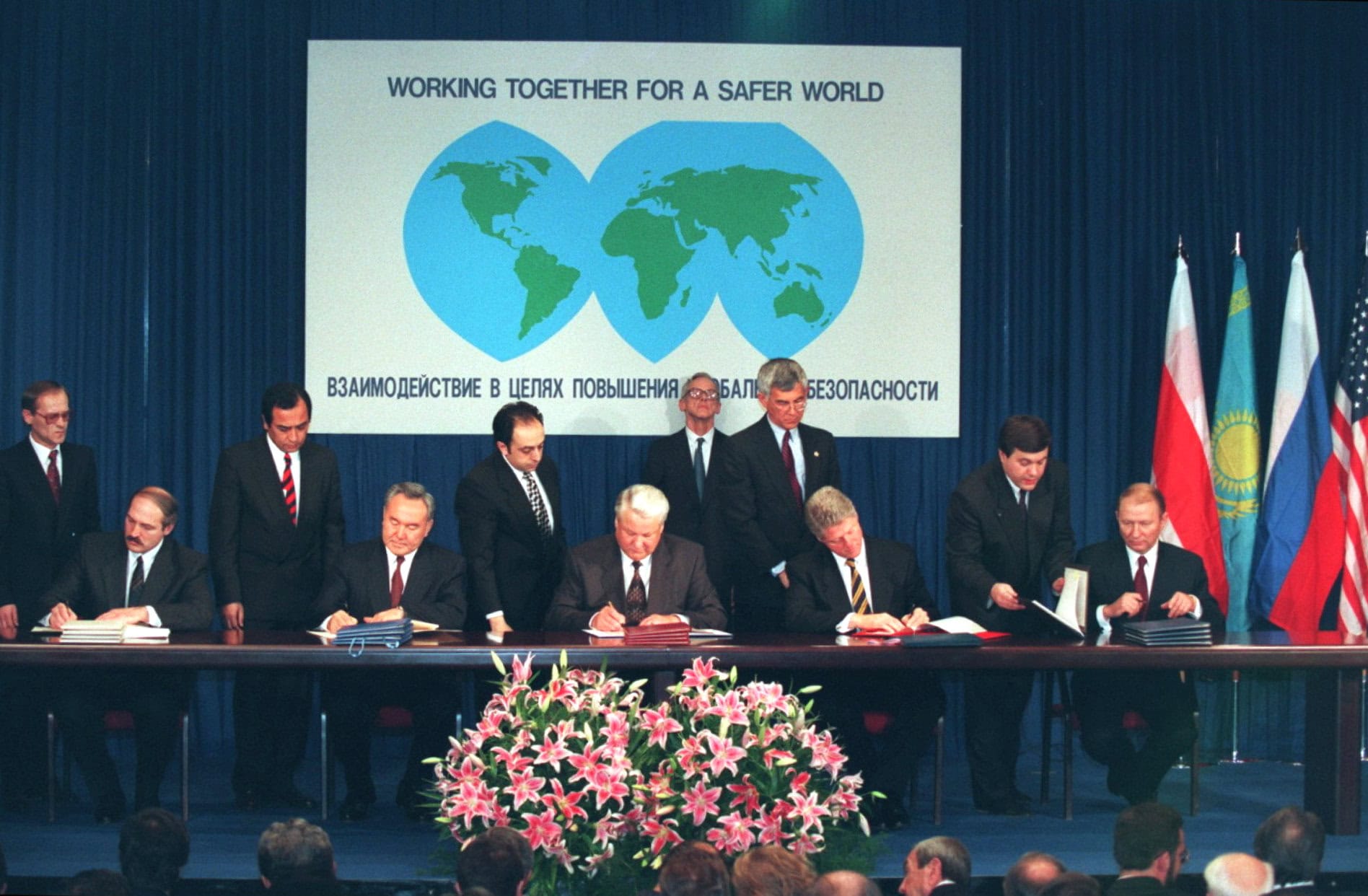
Faith, Power, and the War in Ukraine · Part 2
In Part 1: Standing With Ukraine, I wrote about the people I have come to know in Ukraine and the suffering they have endured because of Russia. In this post, we will examine the record: the commitments, agreements and treaties that Russia negotiated, signed and accepted compared to its subsequent actions.
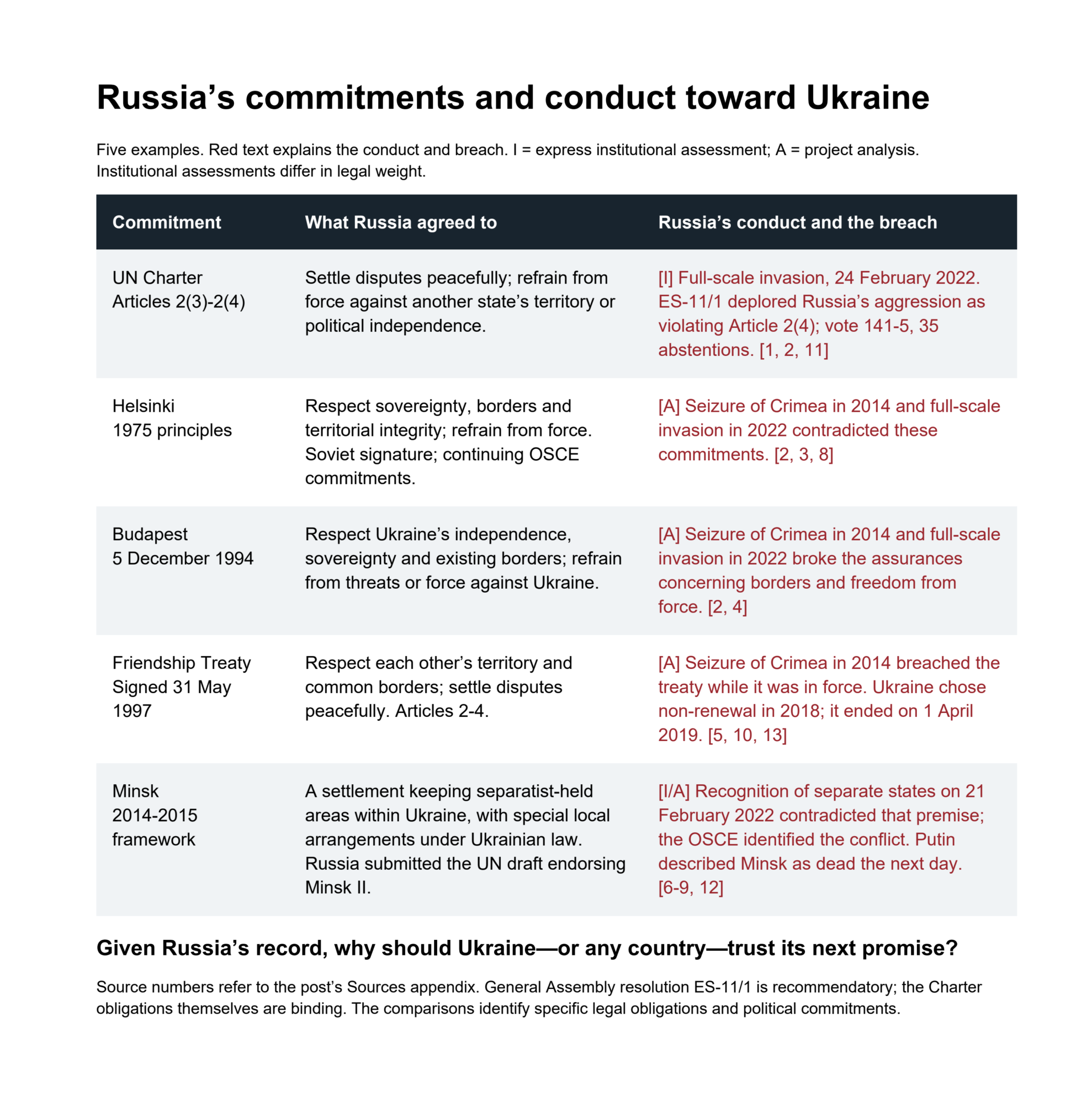
When leaders discuss another agreement with Moscow, we need to ask what happened to the agreements already made. Russia repeatedly committed itself to respect Ukraine’s sovereignty, territorial integrity, freedom, and promised to not use military force against Ukraine. Its subsequent conduct violated all of those commitments.
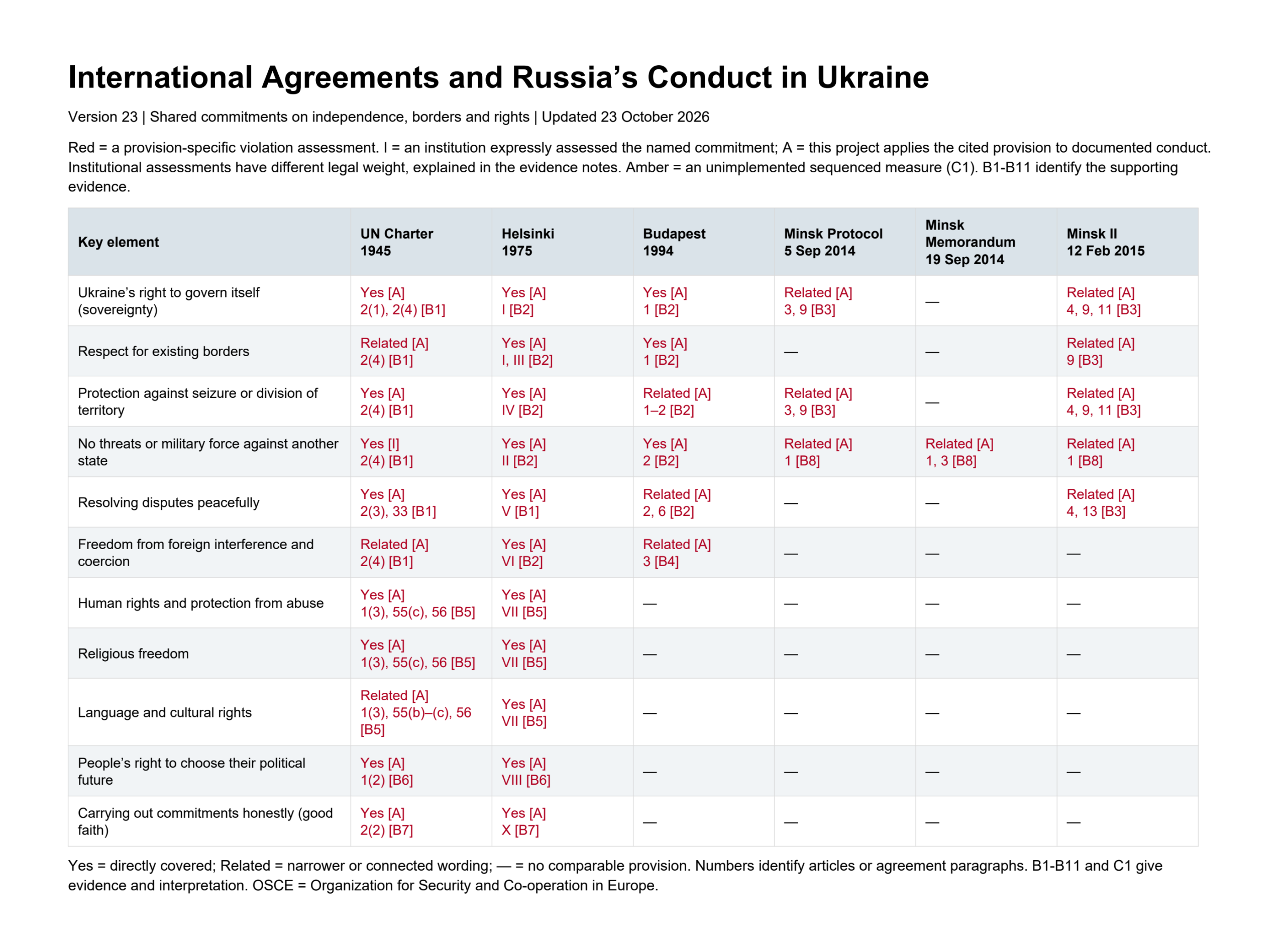
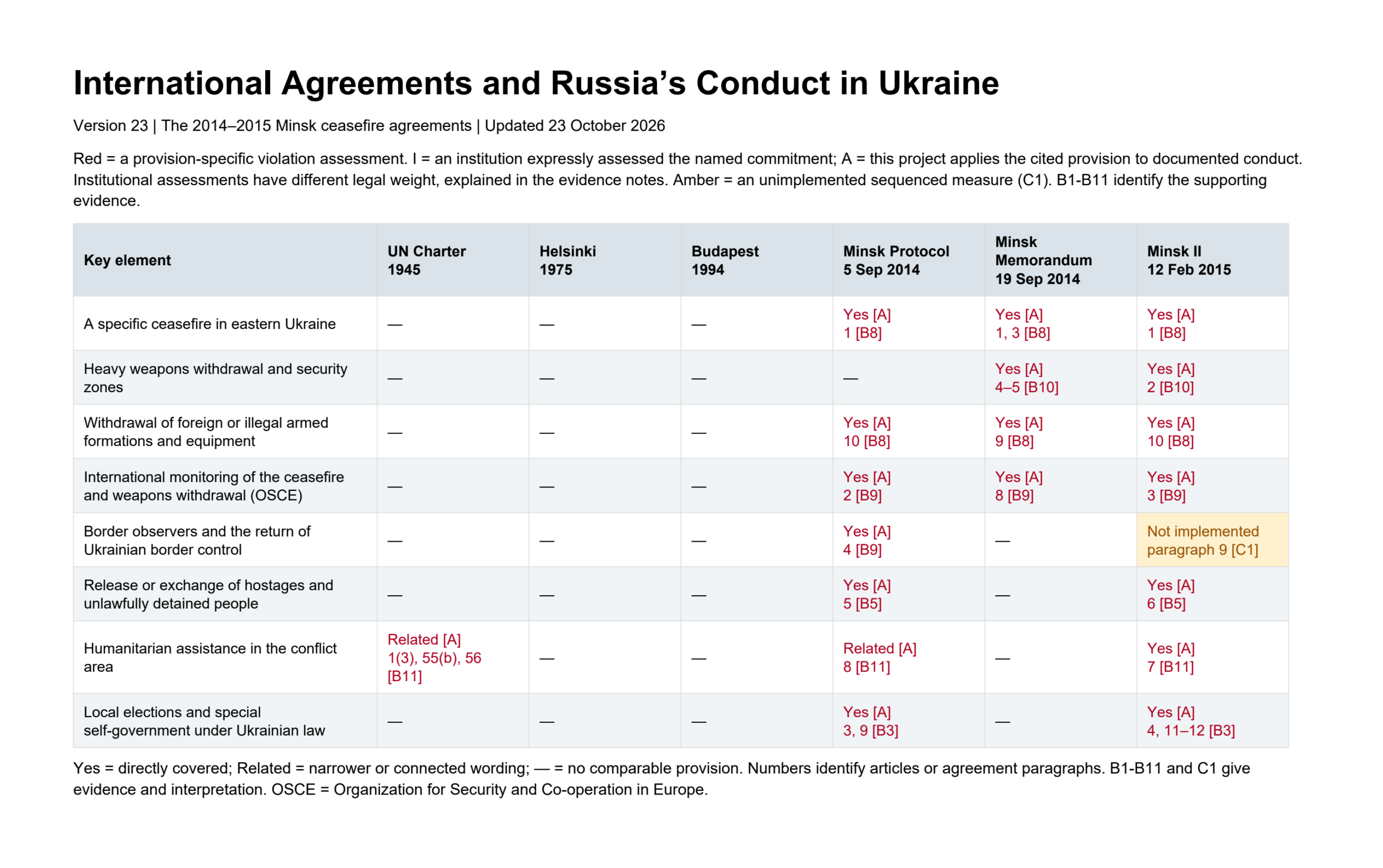
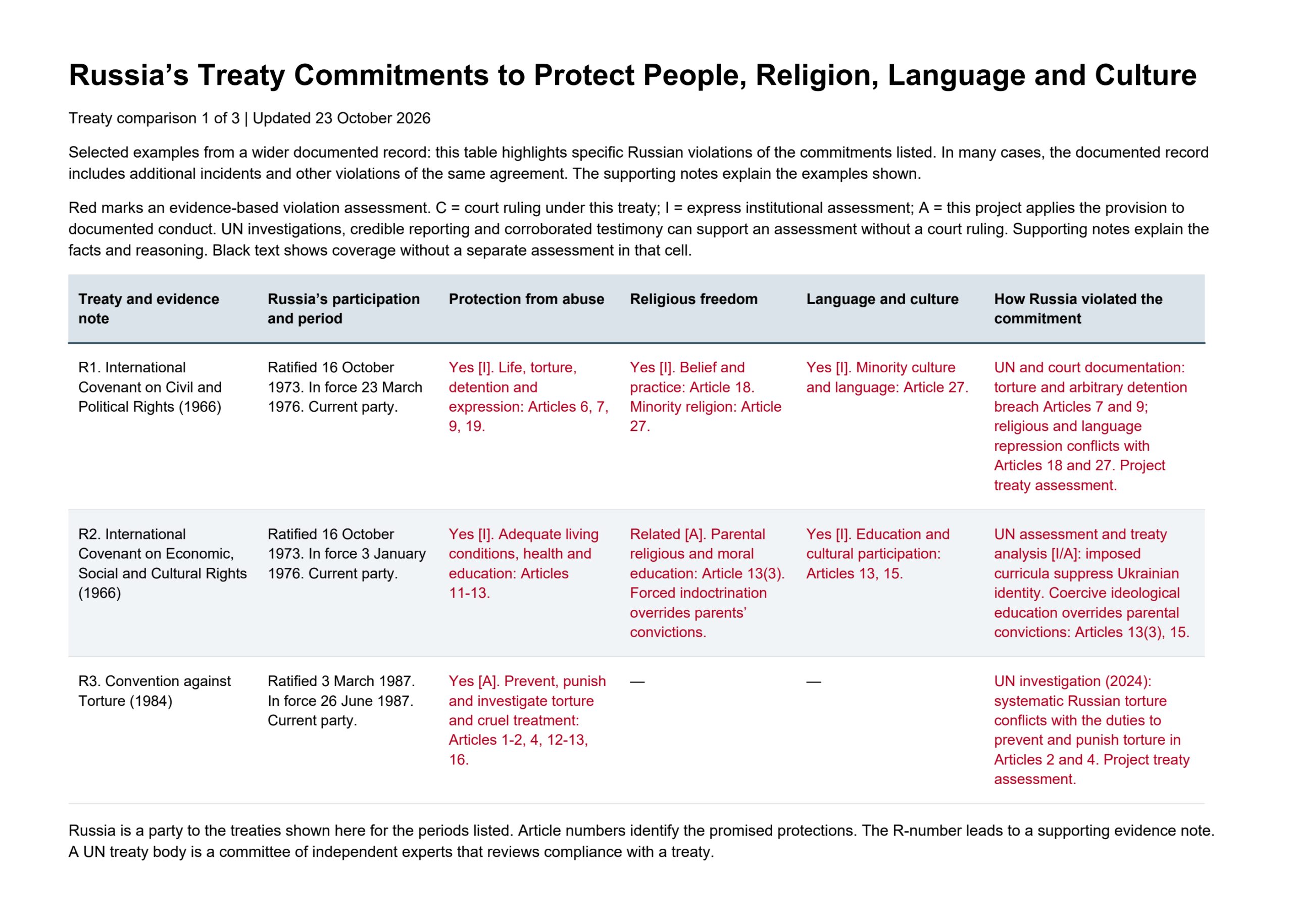
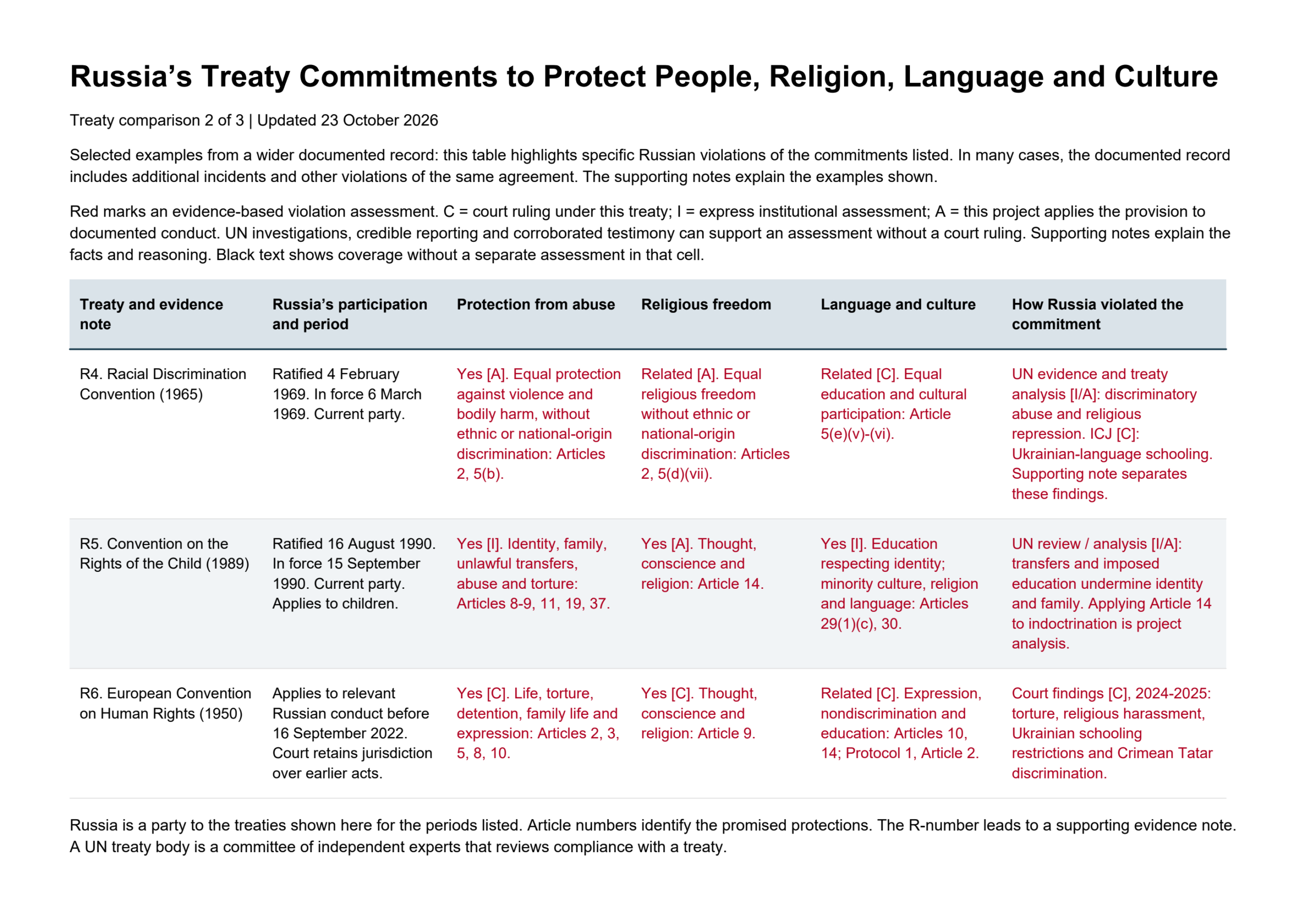
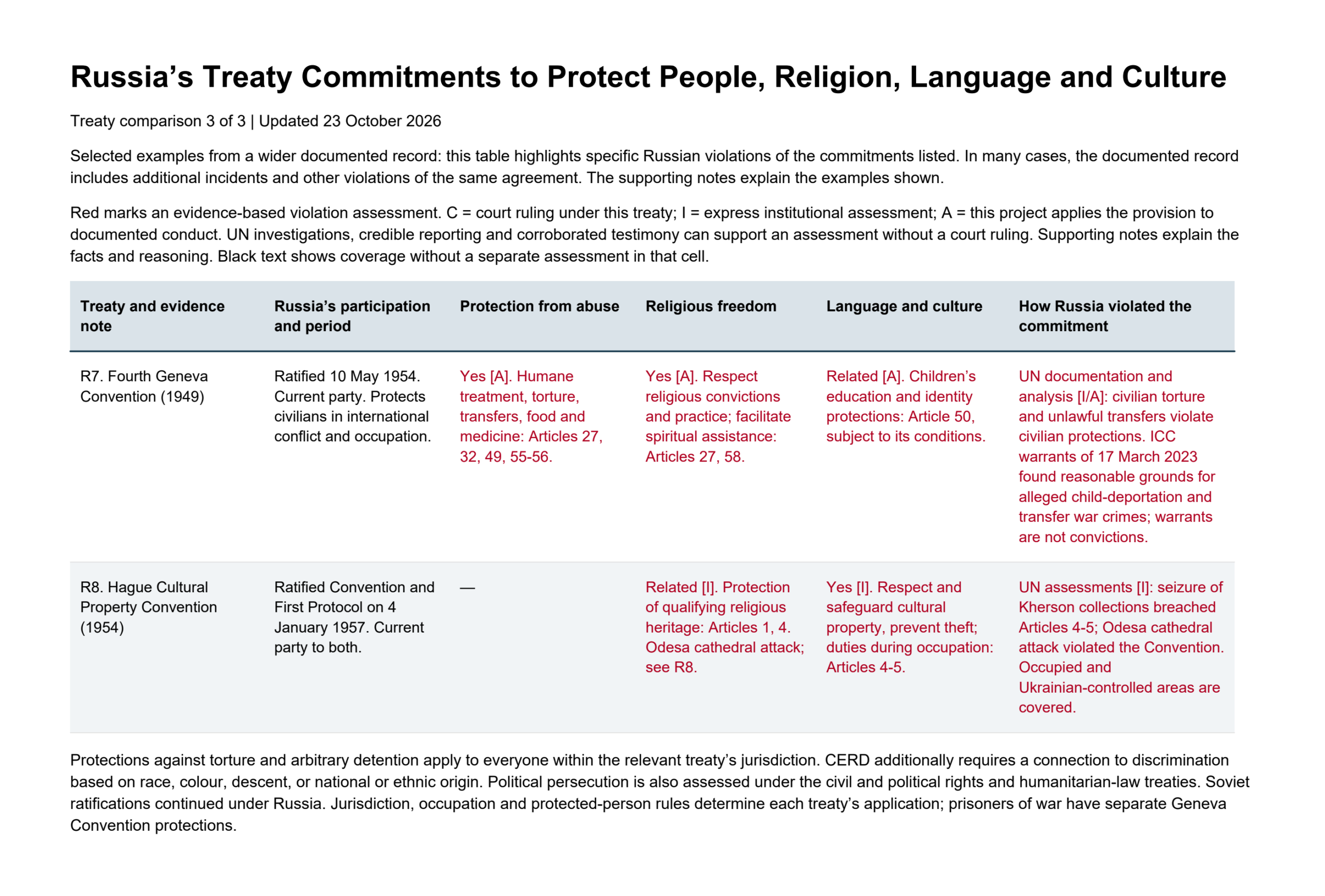
Below are five examples of commitments Russia accepted and subsequently violated. The additional attached tables show a much broader record of violations across agreements protecting sovereignty, borders, human rights, religious freedom, language, and culture.
Commitments Russia Made
1. The United Nations Charter
As a UN member, Russia is bound to settle international disputes peacefully and refrain from force against another country’s territory or political independence. On 24 February 2022, Russia launched its full-scale invasion of Ukraine. On 2 March, the UN General Assembly voted 141-5, with 35 abstentions, for a resolution deploring in the strongest terms Russia’s aggression as violating Article 2(4) of the Charter. Russia attacked the country whose sovereignty the Charter required it to respect. [1, 2, 11]
2. The Helsinki commitments
The 1975 Helsinki Final Act set out principles protecting sovereignty, borders, territorial integrity, and peaceful relations among all nations. The Soviet Union signed it; Russia subsequently participated in the Organization for Security and Co-operation in Europe (OSCE), whose participating states uphold these commitments. Russia’s seizure of Crimea in 2014 and full-scale invasion in 2022 contradicted those principles. Borders were to be respected; Russia used military force to seize Ukrainian territory. [2, 3, 8]
3. The Budapest Memorandum
On 5 December 1994, Russia, the United States, and the United Kingdom gave Ukraine security assurances. These assurances were tied to Ukraine’s agreement to give up its nuclear weapons and join the Nuclear Non-Proliferation Treaty as a state without nuclear weapons. When the Soviet Union collapsed in 1991, Ukraine was left with the world’s third-largest nuclear arsenal. Russia reaffirmed its commitment to respect Ukraine’s independence, sovereignty, and existing borders. It also reaffirmed its obligation not to threaten or use force against Ukraine. Russia then seized Crimea in 2014 and launched its full-scale invasion in 2022. The country that had promised to respect Ukraine’s borders became the country attacking them. [2, 4]
4. The Russia–Ukraine Friendship Treaty
Russia signed this treaty with Ukraine in 1997. Article 2 committed both countries to respect each other’s territorial integrity and the inviolability of their common borders. Articles 3 and 4 also required peaceful relations and settlement of disputes. The treaty was in force when Russia seized Crimea in 2014. That seizure broke its central promises concerning borders and peaceful relations. Ukraine gave notice of non-renewal in 2018; the treaty ended on 1 April 2019. [5, 10, 13]
5. The Minsk agreements
The 2014–2015 Minsk process sought a ceasefire and a political settlement in eastern Ukraine. Russia’s ambassador signed the Minsk texts, and Putin supported Minsk II in a joint leaders’ declaration. Russia submitted the draft that became unanimously adopted UN Security Council Resolution 2202, endorsing Minsk II, on 17 February 2015. The framework kept separatist-held areas of Donetsk and Luhansk within Ukraine, with special local arrangements under Ukrainian law. Despite this agreement, on 21 February 2022 Russia recognized the two separatist entities as independent states, rejecting that central premise. The OSCE identified the contradiction. The next day, Putin described Minsk as already dead and blamed Kyiv. Three days after recognition, Russia launched its full-scale invasion. [6-9, 12, 14]
The Pattern Across the Agreements
Across these different commitments, the pattern is clear: Russia agreed to principles protecting Ukraine’s independence and territory, then acted in direct contradiction to them. The consequences have fallen on the people whose lives those commitments should have helped protect. Russia’s record shows a repeated willingness to disregard commitments when they conflict with its objectives.
This record gives Ukraine, and every country negotiating with Russia, compelling reasons to distrust any promise. A serious discussion of peace must confront that record and the consequences of allowing aggression to succeed.
Again, given Russia’s record, why should Ukraine, or any country, trust its next promise?
What This Series Will Examine
In my following posts in this series, I will be examining how Russia rebuilt its power, how other countries became vulnerable to its pressure, and how Russian political and religious leaders have worked together to justify its actions. I ask you to examine the evidence and Russia’s conduct with me.
The evidence speaks for itself. Will you take the time to understand what is really happening in Ukraine, and why it matters?
Please take action
Please contact your United States senators and your representative in Congress.
Tell them plainly:
“I support Ukraine. I oppose Russian aggression. I want the United States to stand firmly with Ukraine and help it defend its people, freedom, and sovereignty. Russia should not be rewarded for taking another country’s territory by force.”
Do not assume someone else will speak. A phone call or an email takes only a few minutes.
You can call the U.S. Capitol switchboard at (202) 224-3121 and ask to be connected to your senators or representative.
Find and contact your U.S. representative:
https://www.house.gov/representatives/find-your-representative
Find and contact your U.S. senators:
https://www.senate.gov/senators/senators-contact.htm
Find and contact elected officials | USAGov
Use USAGov’s Contact Your Elected Officials tool to get contact information for your members of Congress, the president, and state and local officials.
https://www.usa.gov/elected-officials
Evil triumphs when good people see what is happening and choose to do nothing.
Please do something.
Please share this post with others.
← Previous: Part 1: Standing With Ukraine · Next: Part 3: Do You Have Eyes to See? →
View all articles in this series
Sources
1. United Nations Charter
Articles 2(2), 2(3), 2(4). Certified multilingual text; English Article 2 on PDF page 5, printed page 3.
Click to read the full document:
https://treaties.un.org/doc/Publication/CTC/uncharter-all-lang.pdf
2. UN General Assembly resolution ES-11/1
Adopted 2 March 2022. Operative paragraphs 2-5, PDF page 3: aggression violates Charter Article 2(4); demand for withdrawal; recognition of separatist entities violates Ukrainian sovereignty and territorial integrity. Paragraph 2 uses “deplores in the strongest terms.” This General Assembly resolution is recommendatory, rather than a binding court judgment; the underlying Charter obligations are binding.
Click to read the full document:
https://documents.un.org/api/symbol/access?s=A%2FRES%2FES-11%2F1&l=en&t=pdf
3. Helsinki Final Act
1 August 1975. Principles I-VI: sovereignty, non-use of force, inviolability of borders, territorial integrity, peaceful settlement, non-intervention. English PDF pages 6-9.
Click to read the full document:
https://www.osce.org/sites/default/files/f/documents/5/c/39501_1.pdf
4. Budapest Memorandum
5 December 1994. Paragraphs 1-2: respect Ukraine’s independence, sovereignty and existing borders; refrain from threats or force. Complete signed English text on PDF pages 2-6.
Click to read the full document:
https://treaties.un.org/doc/Publication/UNTS/Volume%203007/Part/volume-3007-I-52241.pdf
5. Russia-Ukraine Treaty on Friendship, Cooperation and Partnership
Signed 31 May 1997; in force 1 April 1999. Articles 2-4: borders, territorial integrity, non-use of force, peaceful settlement. English translation on PDF pages 31-32, printed pages 147-148.
Click to read the full document:
https://treaties.un.org/doc/Publication/UNTS/Volume%203007/Part/volume-3007-I-52240.pdf
6. UN Security Council resolution 2202 and Minsk II package
17 February 2015. Annex I, measures 4, 9 and 11: local elections under Ukrainian law, sequenced border-control handover, constitutional arrangements. Resolution endorsed the package; Annex II records leaders’ support.
Click to read the full document:
https://digitallibrary.un.org/record/787968/files/S_RES_2202(2015)-EN.pdf
7. OSCE Special Representative Mikko Kinnunen on Russian recognition
Statement dated 21 February 2022; web page dated 22 February. Explains that Russian recognition contradicted the Minsk aim of those areas remaining part of Ukraine with special status.
Click to read the full document:
https://www.osce.org/chairmanship/512695
8. OSCE leaders on Russia’s recognition of parts of Ukraine
21 February 2022. Identifies a breach of international law and fundamental OSCE principles and a contradiction of the Minsk agreements.
Click to read the full document:
https://www.osce.org/chairmanship/512686
9. UN Security Council meeting record S/PV.7384
17 February 2015, page 2: the Russian Federation submitted draft S/2015/117; unanimous adoption as resolution 2202.
Click to read the full document:
https://documents.un.org/api/symbol/access?s=S%2FPV.7384&l=en&t=pdf
10. Ukrainian law terminating the Friendship Treaty
Law 2643-VIII, adopted 6 December 2018, provides for termination from 1 April 2019.
Click to read the full document:
https://zakon.rada.gov.ua/laws/show/2643-19?lang=en
11. UN General Assembly voting record
A/ES-11/PV.5, 2 March 2022: 141 in favour, 5 against, 35 abstentions.
Click to read the full document:
https://documents.un.org/api/symbol/access?s=A%2FES-11%2FPV.5&l=en&t=pdf
12. Putin’s answers to media questions, 22 February 2022
Kremlin transcript reproduced by GlobalSecurity. Putin described Minsk as already dead and attributed the collapse to Kyiv. This is evidence of his stated position.
Click to read the full document:
https://www.globalsecurity.org/wmd/library/news/ukraine/2022/ukraine-220222-kremlin04.htm
13. Ukrainian non-renewal notice in 2018
PISM’s contemporary analysis, dated 21 September 2018, records Ukraine’s official notice of non-renewal that day. The UN October 2018 treaty-registration statement records termination effective 1 April 2019. Complete archived PISM text and the UN registration record are included in the supporting sources.
Click to read the full document:
UN treaty-registration record: Click to read the full document:
https://treaties.un.org/doc/Publication/Monthly%20Statement/2018/10/monstate.PDF
14. Minsk Protocol signed on 5 September 2014
Complete signed Russian original, published by the OSCE. The two-page protocol has twelve measures; PDF page 2 identifies Russian Ambassador Mikhail Zurabov and shows his signature alongside the other participants.
Click to read the full document:
Russian original:
https://www.osce.org/sites/default/files/f/documents/a/a/123258.pdf
English translation (University of Edinburgh PA-X):
https://www.peaceagreements.org/media/documents/ag1363_56bdc1ef10dcf.pdf
The attached tables show additional commitments Russia made, how it violated them, and the supporting sources.
3 thoughts on “Part 2: Given Russia’s Record, Why Trust Its Next Promise?”